
Mapping the Future of Work: An Introduction to the Human–AI Task Tensor
Book chapter to be published in the Handbook of AI and Strategy edited by Felipe Csaszar and Nan Jia

In just a few years, generative AI has gone from a curiosity to a constant companion in many workplaces. Yet for all the excitement—and anxiety—surrounding its potential, there remains a basic problem: we still lack a clear way to describe the work that AI and humans do together. We talk about augmentation and automation or different use cases, but we lack a systematic way to organize how we think about how a human and AI perform tasks together. That's why my colleague Alastair Moore and I conceived of the human–AI task tensor. We have written a paper titled “Toward a Human–AI Task Tensor: A Taxonomy for Organizing Work in the Age of Generative AI” that is going to be published in the Handbook of AI and Strategy edited by two leading researchers in the field of AI and strategy and organizations, Felipe Csaszar and Nan Jia.
In mathematics, a “tensor” is a multidimensional object. The human–AI task tensor is similar to this idea. We conceive of tasks being performed by humans and AI across eight dimensions: task definition, AI contribution, interaction modality, audit requirement, output definition, decision-making authority, AI structure, and human persona. Together, these dimensions let us abstract away from specific tasks to describing them in terms of how the human and AI interact to complete it.
The tensor gives rise to a visualization tool: the Human–AI Task Canvas. This canvas allows us to map any task across the eight dimensions. It helps us identify clusters of similar tasks, compare workflows, and potentially spot opportunities for applications that span seemingly disparate tasks.
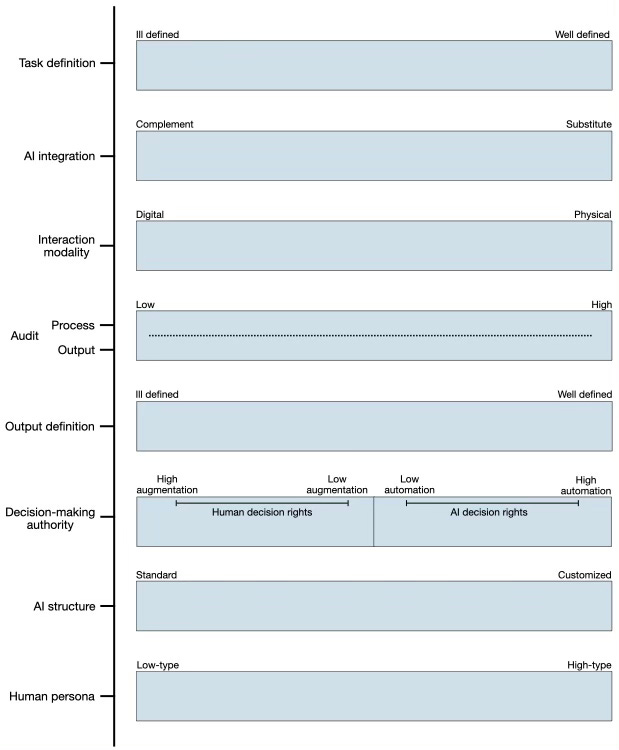
The human–AI task tensor helps us organize our thinking about using AI inside organizations by considering questions like: To what extent is the output of this task well-defined? Does it require oversight? Is the AI being used as a tool or as a teammate? How mature is the AI system? These questions are more actionable for managers and potentially more insightful for researchers.
The canvas also lets us see when very different tasks actually share similar profiles. For instance, tutoring a student in math and giving feedback on a written essay may look quite different at first glance. But both could be well-defined in terms of output, involve high levels of human oversight, and benefit from an AI assistant that offers suggestions rather than making final decisions. Mapping these tasks on the canvas reveals shared characteristics that might otherwise be hidden.
Over the next series of posts, I’ll dive into each of the eight dimensions in detail, then introduce three derived frameworks that simplify and focus the tensor: the AI Function Matrix, the Task Augmentation/Automation Scale, and the Task Audit Matrix. I’ll end with a forward-looking discussion of how the tensor might evolve as AI capabilities and work itself continue to change.
For now, feel free to take a look at the book chapter and let me know if you have any questions that I can answer as I write more about it.